Written by Cherish McMillan-Kilgoe and Jamila Jones
Edited by Dessane Lopez Cassell
In the Eastern Panhandle of West Virginia, history lives not only in archives but in voices, homes, and creative practices passed down through generations. In Charles Town, Innovative Community Solutions (ICS) stands at a dynamic crossroads of tradition and innovation, weaving arts and culture into preservation. Through projects like the Affrilachian Trail, the Weaver–Gillison House, and the Webb Blessing House, ICS shows how creative practices can keep Appalachian stories visible, felt, and alive while strengthening local communities.
Founded with a commitment to community-rooted development, ICS approaches preservation as a living engine for local prosperity. Its work is grounded in restoring historically significant sites, but it does not stop at stabilizing bricks and mortar. These places become catalysts for neighborhood revitalization – drawing visitors, supporting small businesses, and creating venues for artists, educators, and cultural programs.
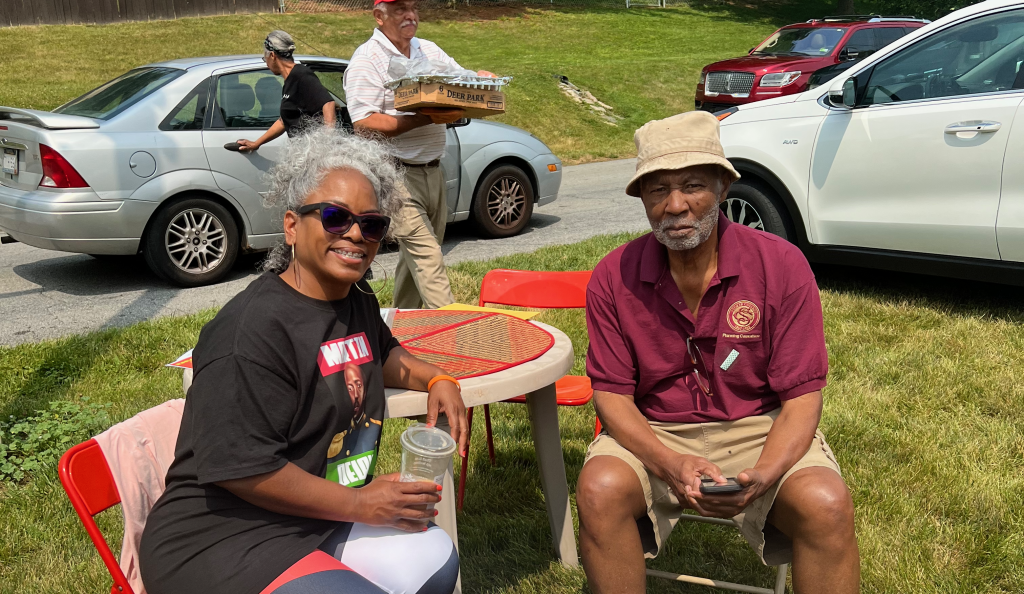
Community elder George Rutherford, founding member of the Jefferson County Black History Preservation Society, embodies the roots of that work. Now in his 90s, he has spent decades collecting oral histories, artifacts, and memories that were at risk of disappearing, only to realize that “time was short and the people we needed to get the information from were dead.” For Rutherford, preserving Appalachian history is about ensuring that these experiences are recognized as part of the larger American story. He now looks to ICS to carry that work forward, saying, “If I can tell [Jamila at ICS] all I know and give her all the information I got, hopefully she can take it and further it up.”
Display caption
Jamila Jones and George Rutherford, Founding member of the Jefferson County Black History Preservation Society at the Jefferson County NAACP Juneteenth Celebration, 2023. Credit: Jamila Jones.
Arts and culture are the tools ICS uses to “take it further.” Through collaborations with elders, educators, and local organizations, the group turns traditional practices – oral history interviews, memory-sharing, church and lodge archives – into performances and digital stories. Audio recordings and multimedia storytelling allow these narratives to travel beyond local boundaries while remaining rooted in place.
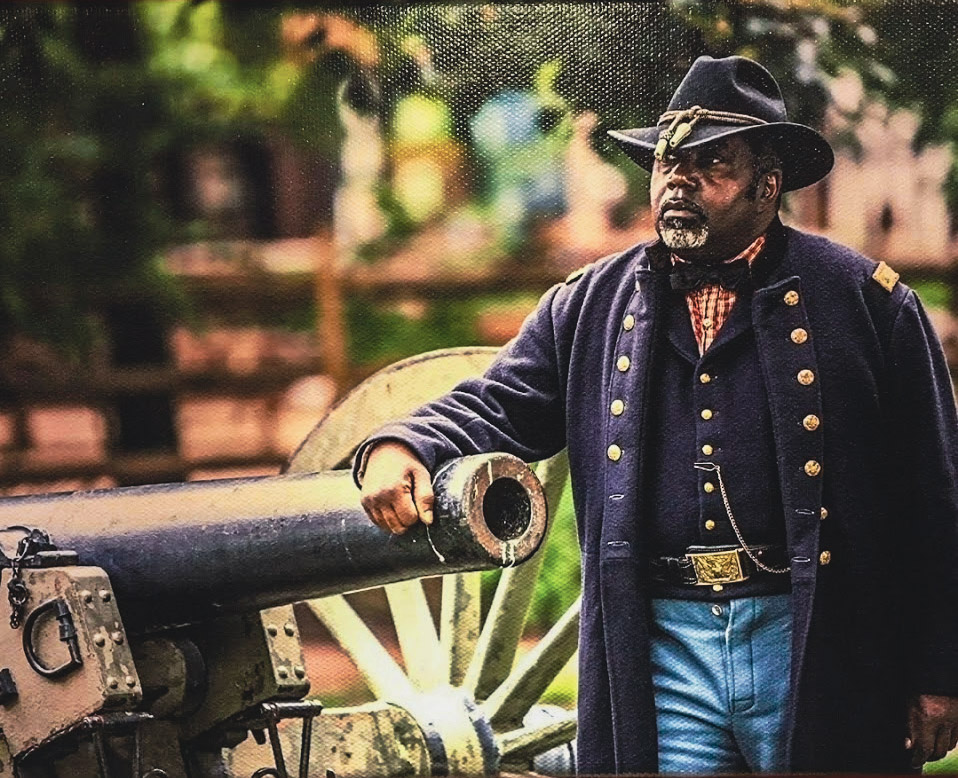
Black history educator and living history performer Timothy Hodge shows what this looks like in the room. Through first-person historical interpretation, he brings figures such as Martin R. Delany and Robert Smalls to life for present-day audiences. “When I stand in front of somebody,” he explains, “I’m bringing that crowd into that time period so they can see and feel the joy, the enlightenment, the pain.” For young people who rarely see themselves reflected in textbook versions of Appalachian history, that experience can be transformative; it proves, as Hodge says, “that we can be something and we can do something.”
Display caption
Timothy G. Hodge re-enacting Martin Delany in Gettysburg, PA, 2019. Credit: Timothy G. Hodge.
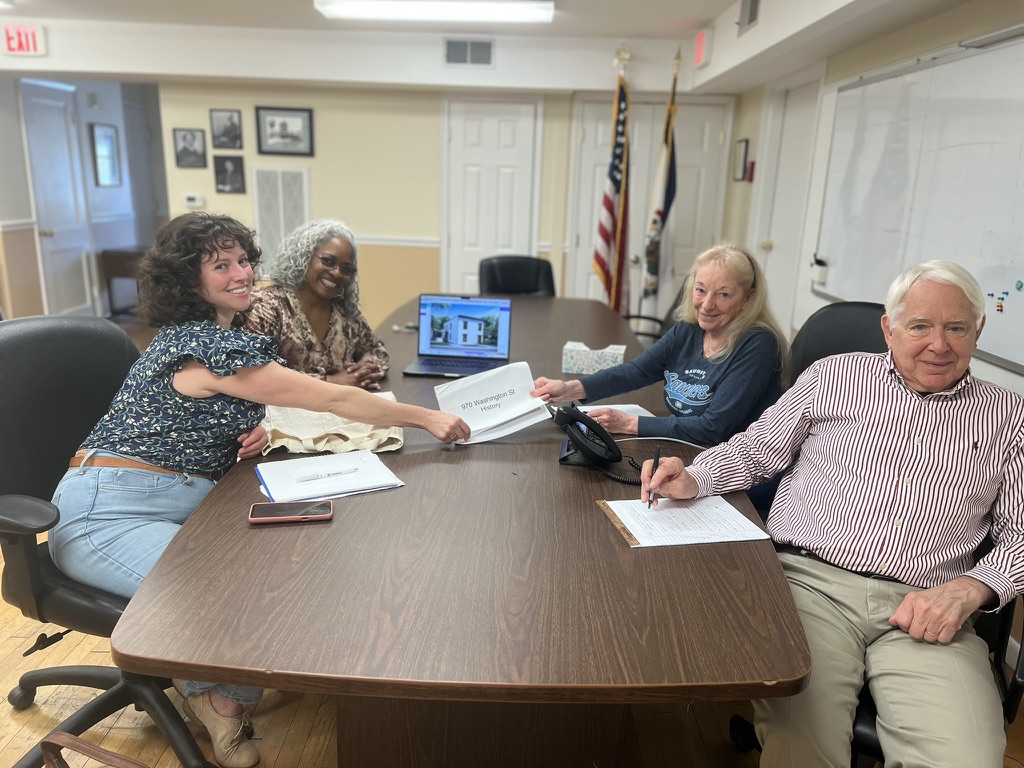
Local leadership also recognizes the power of combining preservation with cultural expression. Commissioner Caitlin McAteer of the Harpers Ferry Historic Landmarks Commission highlights a restored home as more than an architectural landmark. “You cannot separate architecture from the stories that made it happen,” she reflects. “Architecture is a physical manifestation of people’s stories.” By partnering with ICS on survey and planning efforts, the Commission is rethinking what it means to safeguard those stories, treating preservation not as an endpoint but as the beginning of deeper community engagement and future arts programming.
Display caption
Commissioner Caitlin McAteer and Jamila Jones in a meeting discussing the preservation of the Weaver Gillison House, with Harpers Ferry Mayor Greg Vaughn and Administrative Officer Pat Morse. Credit: Jamila Jones.
At the heart of ICS’s approach is the conviction that arts and culture are essential community infrastructure, not extras – even when funding landscapes and project timelines shift. A stabilized building can become a rehearsal space, a neighborhood exhibit, or a site for intergenerational dialogue, but ICS has also learned to treat programming itself as infrastructure. When one path closes, the organization pivots: recent support from Mid Atlantic Arts is helping launch Appalachian Roots: Porchsongs for Weaver–Gillison, a gathering and fundraiser for rehabilitation work at the historic home. At the Webb Blessing House, a new grant from the National Trust for Historic Preservation will underwrite an Interior Preservation & Interpretation Plan for the kitchen, turning a space of everyday labor into a studied site of Black Appalachian domestic history. In both cases, creative practice not only honors heritage; it actively finances its preservation.
Display caption
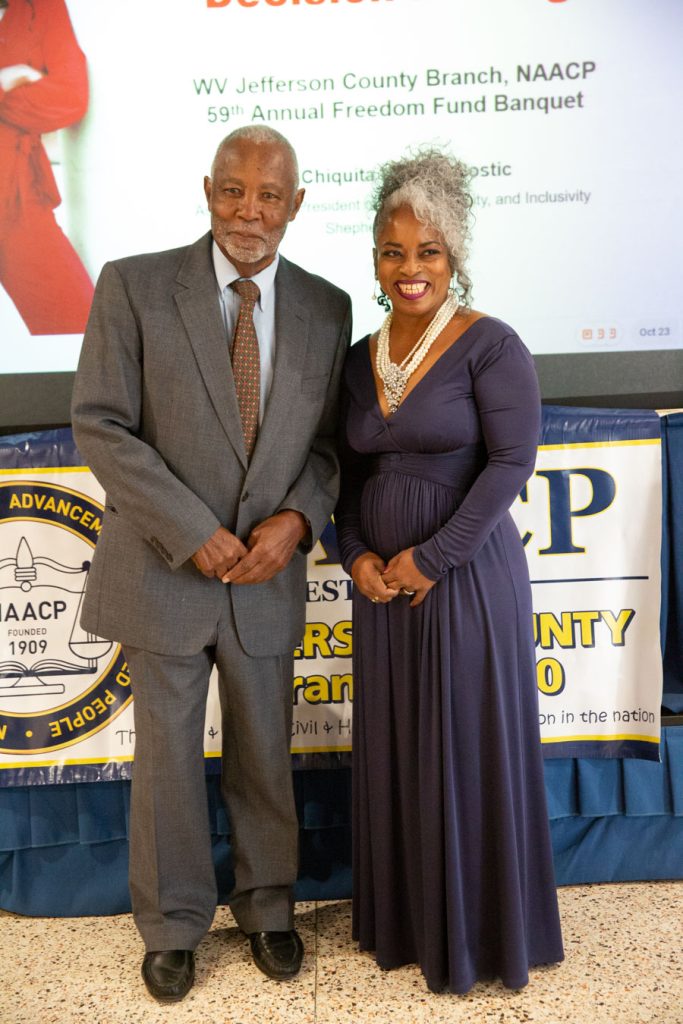
Jamile Jones and George Rutherford at the 59th Annual Jefferson County WV NAACP Freedom Fund Banquet. Mr. Rutherford was recognized for 60 years of service as the Jefferson County NAACP President as he prepared to retire the position. Credit: Jamila Jones.
Jamila Jones, founder and Executive Director of ICS, describes her long-term vision as building a “blueprint – a repeatable plan to save stories and preserve history – not only in Harpers Ferry, but throughout Appalachia.” In practice, that blueprint has become a living document, reshaped by losses, new partnerships, and lessons in what it takes to keep heritage work alive. Much like figures Delany or Rutherford, who navigated changing currents while insisting that Black Appalachian experience belong in the American story, ICS is learning to adjust course without abandoning its core commitments. The blueprint depends on artists, elders, and institutions working together, and on a willingness to pivot – to turn performances into fundraisers, planning grants into preservation strategy, and moments of uncertainty into new routes for community-rooted work.